The residential property landscape of the Albury-Wodonga region represents a Tier-1 regional investment opportunity characterized by high economic complexity and structural scarcity. As of mid-2026, the twin cities straddling the New South Wales and Victorian border have transitioned from their historical role as agricultural service centers into a diversified metropolitan corridor that serves as the primary logistics and healthcare hub for the Australian inland. This report, prepared by the analytical team at AssetFlow Australia, provides an exhaustive data-driven evaluation of the region, identifying the causal relationships between infrastructure investment, demographic shifts, and property market performance.
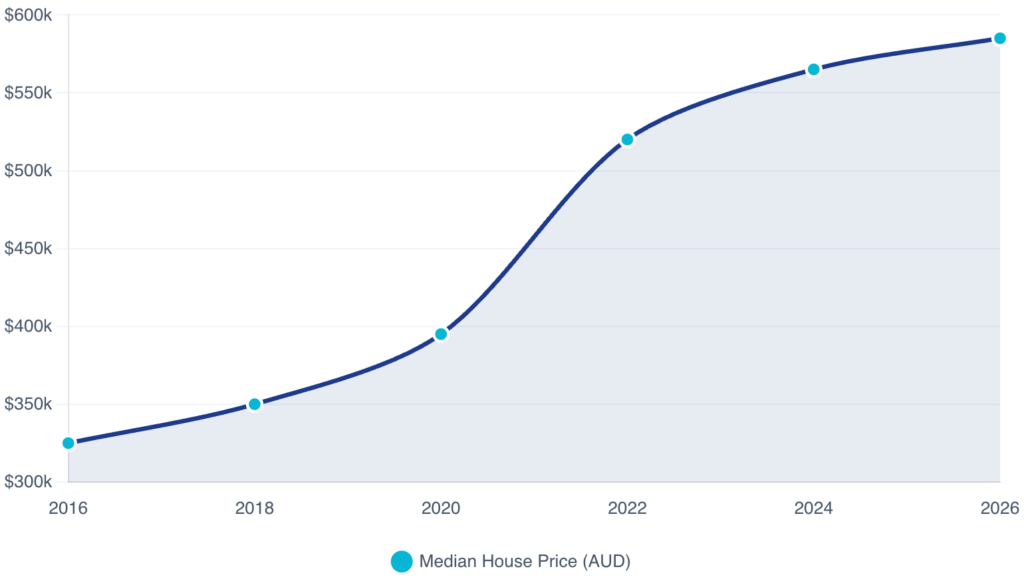
The fundamental investment thesis for Albury-Wodonga is based on a “second-wind” market dynamic. Following a significant price escalation between 2021 and 2023, where annual house price growth frequently exceeded 15%, the market has undergone a period of healthy consolidation. Current data indicators suggest a renewed momentum driven by a critical undersupply of housing, an expanding professional workforce, and a multi-billion-dollar infrastructure pipeline that is currently reaching its implementation phase.
Regional Economic Architecture and Commercial Vitality
The resilience of the Albury-Wodonga property market is anchored in an economic base that avoids the volatility associated with single-industry towns. The analysis identifies five core pillars: healthcare, manufacturing, construction, education, and public administration. This diversity creates an economic floor, ensuring that the residential market is insulated from broader macroeconomic shocks that typically affect mining or tourism-dependent regions.
Gross Regional Product and Business Formation
Economic indicators as of late 2025 show a Gross Regional Product (GRP) of approximately $9.64 billion for the combined region, reflecting a 4.3% growth over the preceding financial year and a significant 29% increase since 2019. For the Albury sub-sector alone, the GRP reached $5.25 billion, demonstrating a higher growth rate than the regional average.Such growth in regional output serves as a primary driver for housing demand, as increased productivity necessitates a larger labor pool and higher-quality residential infrastructure.
The business environment is characterized by steady formation and professionalization. As of 2024, Albury was home to 5,218 businesses, representing a 13% expansion over five years. The structure of these businesses—predominantly small to medium enterprises (SMEs) and sole proprietorships—underpins a flexible and resilient jobs market.
| Economic Metric | Combined Region (Albury-Wodonga) | Albury Sub-Sector |
| Gross Regional Product | $9.64 Billion | $5.25 Billion |
| 5-Year GRP Growth | 29% | 32% |
| Business Count (2024) | 8,498 | 5,218 |
| Annual Business Growth | 1.8% | 1.8% |
The Logistics and Manufacturing Hub
Albury-Wodonga’s strategic position on the Sydney-Melbourne-Canberra triangle makes it the most significant freight and distribution node in inland Australia. The Hume Highway corridor and the Melbourne-Sydney rail line provide businesses with the unique advantage of reaching 75% of the Australian population overnight. This logistics capability has resulted in the establishment of high-output industrial precincts that provide stable, long-term employment.
Key industrial and commercial drivers include:
- Manufacturing Revenue: This sector contributes approximately 18.5% of total regional revenue, making it the largest financial contributor to the local economy.
- Major Industrial Hubs: Logic Wodonga and Nexus Albury are master-planned precincts that continue to attract high-growth businesses in beverages, pet care, and plastics recycling.
- Corporate Presence: The region serves as a base for national entities such as Mars Petcare, Asahi Beverages, Circular Plastics, and the Woolworths Distribution Centre.
For residential investors, this industrial activity translates into “structural demand.” Workers in these high-productivity sectors require diverse housing options, ranging from affordable rentals in Lavington to executive family homes in Thurgoona.
Infrastructure Catalysts and Future Capital Growth
Infrastructure investment is a critical component of AssetFlow Australia’s “Property Trifecta” (Equity, Cashflow, and Growth). Albury-Wodonga is currently experiencing a record level of government and private capital expenditure, which serves as a leading indicator for future capital appreciation in the residential sector.
The Health Hub: $558 Million Hospital Redevelopment
The most significant immediate catalyst for the residential market is the $558 million redevelopment of the Albury Wodonga Regional Hospital. This project is not merely a replacement of old facilities but a massive expansion of the regional medical workforce.
The detailed scope of the redevelopment includes:
- Clinical Services Building: A new 7-storey facility designed to consolidate complex care.
- Bed Capacity: The addition of 110 new overnight beds, including specialized medical and surgical units.
- Specialized Facilities: New mental health units, neonatal care, cardiac catheterization labs, and digital operating theatres.
- Staffing Impact: The expansion of specialized services attracts high-income medical professionals (specialists, registrars, and senior nursing staff) who typically seek premium rental properties or purchase high-end homes near medical precincts.
The localized impact of this project is most evident in the Albury CBD and East Albury, where proximity to the hospital campus is a primary selection criterion for high-value tenants.
Transportation and Freight Infrastructure
Connectivity upgrades are reshaping the region’s logistics viability. The $31.4 billion Inland Rail project is enhancing the freight corridor from Melbourne to Brisbane, with Albury-Wodonga serving as a critical interchange point. Furthermore, specific Albury-to-Parkes rail upgrades totaling $403 million are increasing the efficiency of the Sydney-Melbourne corridor.
Expansion at the Albury Airport, including the $5 million Taxiway Alpha extension, enhances access to the Western Precinct and supports aviation-related industries. These transport investments underpin long-term logistics viability, ensuring the region remains an attractive location for national distribution centers, which in turn fuels employment and population growth.
Renewable Energy and Technological Integration
The region is positioning itself as a pioneer in the new energy economy. A $655 million hydrogen plant and several large-scale solar farms are in various stages of development. The $44 million hydrogen park in Wodonga represents Australia’s first facility of its kind, attracting a new demographic of technical and scientific professionals to the region.
| Infrastructure Project | Estimated Value | Sector | Status (2026) |
| Regional Hospital Redevelopment | $558 Million | Healthcare | Planning/Early Works |
| Inland Rail Link | $31.4 Billion | Transport | Active Development |
| Wodonga CBD Renewal (Junction Place) | $765 Million | Urban Renewal | Ongoing |
| Advanced Manufacturing Centre | $2 Million | Education | Commencing 2025 |
| Albury Airport Expansion | $5 Million | Aviation | Active |
| Regional Hydrogen Plant | $655 Million | Energy | Planned |
Demographic Dynamics and Housing Demand Trends
Property analysis must always begin with a deep understanding of the residents who will occupy the dwellings. The Albury-Wodonga demographic profile is characterized by professionalization and a younger age structure compared to broader regional New South Wales.
Population Growth and Migration Patterns
The combined population of the twin cities has reached approximately 103,141 as of mid-2024. Population growth has normalized to an annual rate of 1.3%, which is significantly higher than the regional NSW average of 0.86% to 0.9%. Long-term forecasts suggest Albury City alone will reach 77,000 residents by 2046, reflecting a 37.8% increase from 2021 levels.
Internal migration remains a primary driver. During the 2021-2023 period, the region saw a surge in arrivals from major capital cities, particularly Melbourne and Sydney, as buyers sought the balance of “regional lifestyle” and “metropolitan infrastructure”. While this pace has normalized, the region continues to attract high-skill migrants in health, manufacturing, and logistics.
Household Composition and the Professional Class
The “occupational profile” of the region is shifting toward professional services. In Albury, “Professional” is the predominant occupation category. This correlates with the presence of major educational institutions such as Charles Sturt University (Albury) and La Trobe University (Wodonga), which support a student population of nearly 5,000 and a high concentration of academic and administrative staff.
| Demographic Metric | Albury (NSW) | Wodonga (VIC) |
| Median Age | 39 | 38 |
| Working Age (15–64) | 61.7% | 61% (Est.) |
| Lone-Person Households | 31% | 30% (Est.) |
| Percentage Rented | 34% | 29% |
| Median Weekly Income | $1,430 | $1,441 |
Lone-person households comprise the largest share at 31%, followed by couple-families without dependents at 27%. This is a critical insight for investors: the region has a high demand for 1-2 bedroom units and townhouses, yet the existing stock is heavily weighted toward larger 3-4 bedroom standalone houses. This mismatch represents a strategic opportunity for those developing or acquiring medium-density dwellings.
Property Market Performance and Value Indicators
The Albury-Wodonga property market is currently defined by a divergence between a “consolidating” sales sector and an “overheated” rental sector. Following the boom of 2021–2022, where house prices grew by more than 15% annually, the market has settled into a phase of moderate, sustainable appreciation.
Sales Market Normalisation
As of early 2026, median house prices in the combined region sit at approximately $592,500, with a 12-month growth rate of 2.6%. However, the Albury (NSW) sub-market shows more aggressive price points, with median prices reaching $925,000 to $937,500 in premium pockets.
The analysis indicates high “market pressure” despite slow headline growth. This is evidenced by:
- Inventory Levels: Stock levels hit a record low of 1.6 months in early 2024 and have remained critically tight at 1.7 to 1.8 months through 2025.
- Vendor Discounting: Discounts have tightened to just -0.2% in Albury, indicating that sellers are achieving their full asking prices in most transactions.
- Days on Market: Properties in high-demand suburbs like North Albury or Thurgoona are selling in 31 to 34 days, significantly faster than the regional average.
The “Border Bias” and State Policy Impact
A unique feature of this market is the “border gap.” PropTrack data identifies a median house price difference of over $325,000 between Albury ($902,500) and Wodonga ($575,000). This gap is not purely geographical but driven by two distinct factors:
- Lifestyle Preference: Albury is perceived to offer more sophisticated nightlife and commercial amenities, attracting more “emotional” buyers.
- Tax Regimes: Victorian land tax and stamp duty policies have become increasingly punitive for investors, often driving capital across the river into New South Wales.
| State Comparison (2026) | New South Wales (Albury) | Victoria (Wodonga) |
| First Home Stamp Duty Exemption | Up to $800k | Up to $600k |
| Stamp Duty on $1M Property | ~$39,412 | ~$55,000 |
| Land Tax Threshold (Individual) | $1,075,000 | $50,000 |
| Short-Stay Levy (Airbnb) | N/A | 7.5% of revenue |
The Rental Market Crisis: Landlord Yield and Vacancy
While capital growth has moderated, the rental market in Albury-Wodonga has entered a state of crisis. For investors, this is the most compelling aspect of the region, providing a significant cashflow buffer against high interest rates.
Crisis-Level Vacancy Rates
The regional vacancy rate has declined to approximately 0.5%, a level described as “extremely tight”. In Albury proper, the rate was 1.5% in December 2025, while North Albury sits at a critical 0.6%. Such low vacancy indicates that rental properties are typically tenanted before they are even officially listed, giving landlords massive pricing power.
Rental Growth and Yield Performance
Rents across the region have outpaced sales price growth, leading to improved yields since mid-2023.
- House Rents: Albury recorded a 5.5% increase in median house rents over 12 months, reaching $580 per week.
- Unit Rents: Units have seen aggressive growth of 9.0% to 9.5%, reaching $425 to $450 per week.
- Gross Yields: Albury houses typically yield 3.6% to 3.7%, while Wodonga sits slightly higher at 3.8%. However, specific sub-markets like North Albury provide yields of 5.0% to 5.5% for houses.
- The Unit Advantage: Units in the region consistently push toward a 6% yield, making them highly attractive for cashflow-focused investors.
This high-yield environment is crucial in the current lending climate, as it helps satisfy the “serviceability buffer” required by banks for further portfolio expansion.
Sub-Market Micro-Analysis: Where to Invest
AssetFlow Australia recommends a granular approach to the Albury LGA, as performance varies significantly between the premium CBD and the growth corridors.
Thurgoona: The Master-Planned Growth Engine
Thurgoona is the primary urban expansion zone for Albury. It is characterized by modern housing estates and its proximity to Charles Sturt University.
- Median House Price: $720,000.
- 12-Month Growth: 9.2%.
- Time on Market: Just 34 days, indicating high demand.
- Analysis: This suburb is ideal for investors seeking families as long-term tenants. The high “owner-occupier” appeal of new estates supports stable capital growth and lower maintenance costs.
North Albury: The Yield and Affordability Specialist
North Albury serves as a robust entry point for investors with lower budgets or those prioritizing monthly cash surplus.
- Median House Price: $572,500.
- 12-Month Growth: A standout 21.8% for houses.
- Rental Yield: 5.0% to 5.3%.
- Analysis: North Albury is identified as a “best regional suburb” for 2025/2026 due to its 12% rental growth and 0.6% vacancy rate. It offers the strongest correlation between high yield and recent capital appreciation in the region.
Lavington: The Central Commercial Hub
Lavington acts as a secondary commercial center with diverse dwelling types.
- Median House Price: Approximately $575,000.
- Unit Market: Extremely affordable at ~$317,000.
- Analysis: Lavington has seen a five-year compound growth rate of 28.8% for houses and 30.3% for units. Its proximity to major shopping centers and logistics hubs ensures constant demand from the working-class and essential worker demographics.
Albury Proper (2640): The Blue-Chip Heritage Quarter
The central suburb of Albury represents the premium tier of the market, dominated by heritage homes and professional lone-person households.
- Median House Price: $925,000 to $937,500.
- Rental Yield: 3.6% – 3.7%.
- Analysis: This sub-market is characterized by extreme scarcity, with only 12 properties for sale in a recent monthly snapshot. While yields are lower than North Albury, the CBD offers the highest long-term stability and is the primary beneficiary of the professionalization trend driven by the hospital and university.
Hamilton Valley: The Emerging Value Zone
Hamilton Valley is increasingly being identified as a “buying window” suburb for short-term growth.
- Asking Price: Approximately $855,700.
- Yield: 5.45%.
- Analysis: As prices in Albury CBD and Thurgoona reach their ceiling, buyers are being pushed into Hamilton Valley, creating “ripple effect” growth.
Current Investor Challenges and Market Constraints
Investing in Albury-Wodonga in 2026 requires a nuanced understanding of current structural hurdles.
The Serviceability and Finance Hurdle
Banks continue to apply a 2-3% serviceability buffer on home loans, meaning an investor must be able to afford a 9% repayment even if the variable rate is 6%. This effectively limits the “borrowing ceiling” for many buyers, forcing a strategic shift toward high-yield properties that can “self-service” their own debt.
The Construction and Supply Crisis
While there are over 2,287 land lots planned in Albury, the pipeline for “ready-to-sell” dwellings remains insufficient to meet demand. The construction sector is hampered by:
- Labor Shortages: A critical lack of skilled tradies and construction managers is extending build times for new duplexes or renovations.
- Material Escalation: Building material costs surged in previous years, though they have begun to slow in 2025/2026.
- Insolvency Risk: Investors pursuing development strategies must perform extreme due diligence on builders, as many firms are operating on thin margins in a high-cost environment.
AssetFlow Australia’s guidance is to prioritize “established assets” to avoid these construction-phase risks.
The NSW Land Tax “Silent Trap”
A major regulatory challenge for NSW-based investors is the freeze on land tax thresholds. The 2024-2025 budget fixed the general threshold at $1,075,000. As property values in Albury grow, more investors will find their aggregate land value exceeding this limit, triggering new annual tax liabilities. This is a “lagging but persistent effect” that investors must model into their long-term cashflow projections.
Strategic Investment Recommendations
To maximize risk-adjusted returns in the Albury-Wodonga region, investors should consider the following data-backed strategies.
1. “Manufacturing Equity” via Duplex Development
Building a duplex remains the most effective way to create instant capital uplift. By purchasing a larger block in a suburb like Thurgoona or Hamilton Valley and constructing two dwellings on separate titles, investors can achieve “instant equity” that can be refinanced within 12-18 months to fund the next acquisition. A well-executed duplex provides a dual-rental income, often yielding 6% or higher, which is vital for maintaining borrowing capacity.
2. Targeted Cosmetic Renovation
For those with lower budgets, purchasing older homes in North Albury or West Albury for a “cosmetic TLC” project is recommended. A targeted renovation focusing on the kitchen, bathroom, and floor coverings can return $3 in value for every $1 spent. In a market where stock is scarce, renovated homes command a significant premium from both tenants and emotional owner-occupier buyers.
3. The “Rentvesting” Model
AssetFlow Australia identifies Albury-Wodonga as a prime “rentvesting” destination for metropolitan-based professionals. By purchasing a high-yield property in Albury while continuing to rent in Sydney or Melbourne, investors can benefit from Albury’s 20% price discount compared to the regional NSW average. This allows the regional investment to “subsidize” the investor’s lifestyle in the more expensive city while building an asset base.
4. Prioritizing Land-to-Asset Ratio
Long-term wealth in property is built on the land component. Investors should seek properties where at least 60% of the value is in the land. In Albury-Wodonga, this often means choosing established houses on large blocks (700sqm+) in suburbs like West Albury rather than new, high-density apartments with high strata fees and low land entitlement.
Regional Pros and Cons Analysis
Investors must evaluate the Albury-Wodonga region through a balanced lens of opportunity and risk.
Pros of Investing in Albury-Wodonga
- Economic Diversification: The region has successfully moved beyond its agricultural roots, with healthcare and logistics now providing a stable economic floor.
- Infrastructure Momentum: Billions in committed funding for the hospital and inland rail ensure that the region will continue to professionalize and expand.
- Extreme Rental Pressure: Vacancy rates near 0.5% provide landlords with near-zero vacancy risk and consistent upward rental growth.
- High Yield Profile: Regional yields of 4.8% to 6.0% offer a significant buffer against high interest rates compared to capital cities.
- Strategic Logistics Location: Positioned to benefit from the ongoing growth of the Eastern Seaboard freight network.
- Affordability Arbitrage: Prices remain 65% lower than Sydney and 20% lower than the regional NSW average, offering a lower barrier to entry for new investors.
Cons of Investing in Albury-Wodonga
- Normalizing Capital Growth: Headline appreciation has slowed to 2.6%–5.1%, which may not satisfy investors looking for a “speculative boom”.
- Regulatory Complexity: Navigating the different tax thresholds of NSW ($1.075M) and Victoria ($50k) increases management complexity for multi-property portfolios.
- Construction Delays and Insolvencies: Higher build costs and labor shortages pose significant risks to new-build or development-focused strategies.
- Serviceability Constraints: High bank interest rate buffers limit the amount of leverage available for expansion into the region.
- Long-Term Supply Risks: If the 2,287 planned land lots are delivered simultaneously, it could eventually dilute the current rental pressure.
Conclusion and Future Outlook
The Albury-Wodonga region represents a sophisticated, high-demand residential market that has moved into a sustainable “second-wind” phase. The transition toward a professionalized economy, anchored by the massive $558 million hospital redevelopment and the Inland Rail project, provides a long-term guarantee of residential demand.
AssetFlow Australia concludes that for new investors, the primary strategy should be a focus on “established assets with high land content” in suburbs like North Albury or Thurgoona. By prioritizing gross yields above 5% and vacancy rates below 1.5%, investors can build a resilient portfolio that survives the current high-rate environment while waiting for the next regional capital growth cycle.
Ultimately, the Albury-Wodonga region is not a market for short-term speculation but a strategic destination for long-term wealth building. The ability to manufacture equity through value-add projects in a market with such strong underlying structural demand makes it one of the most compelling regional investment opportunities in Australia for 2026 and beyond.
Investor Action Checklist
- Yield Target: Focus on suburbs like North Albury or Lavington where gross yields exceed 5% to manage interest rate costs.
- Land Value Audit: Ensure the land component represents at least 60% of the total asset value to maximize long-term appreciation.
- State Tax Comparison: Consult with an accountant regarding the land tax implications of the VIC side (Wodonga) vs the NSW side (Albury), as the $50k Victorian threshold can significantly impact net returns.
- Due Diligence on Sub-markets: Look for “quiet streets” within the Albury 2640 CBD or East Albury that are in high demand from medical professionals.
- Audit Builders: If pursuing a duplex or renovation strategy, verify the builder’s solvency and history in the regional NSW market.