1. The Story: The Wentworthville Pivot & The Noida Bridge (2018–2020)
By 2018, life was moving faster than the “forever home” plan we had built in Gledswood Hills. My wife had secured a job in Parramatta, and the daily commute was eating 2-3 hours of her life—every single day. With two young kids at home, those hours weren’t just travel time; they were missed bedtimes and a level of family exhaustion that simply wasn’t sustainable. We had to realign our living arrangements.
We made the difficult choice to move closer to the Parramatta hub. Leaving our own brand-new house to move into a rented townhouse in Wentworthville was a tough psychological hurdle. I remember the anxiety of handing over the keys to our first home to a tenant, worrying they wouldn’t care for it the way we did. At that stage, we didn’t even think we’d buy a second house. We weren’t “investors” by choice; we were investors by necessity. Our Gledswood Hills home became an asset by default, and while the rent didn’t cover the mortgage, we were just focused on saving those three hours of commute time to be there for the kids.
In late 2019, life took an unexpected turn. My father was diagnosed with prostate cancer. I dropped everything and flew back to India to meet specialists along with him. Those two weeks were a blur of hospital corridors and specialists. Amidst that darkness, I realised that I could settle the Noida apartment situation—the property that had grown from a small piece of land in Meerut years earlier. Between doctor visits, I was meeting property dealers and showing the apartment to buyers. We found a buyer, set a clear treatment path for Dad, and suddenly, things didn’t seem so dark.
That sale became the bridge. It funded the deposit for our second home in Wentworthville—a 1957 fibro “time capsule.” We bought it from a lady who had been born in that house and then bought it from her father once he retired. When she realised we were a family who wanted to raise our kids there, and not developers wanting to knock it down, she chose us over other potential buyers (At least I’d like to see it that way, as we inspected the house a few times and came with the family so she knew we were trying to find a home). We settled in early 2020, just as the world began to lock down for COVID. Looking back, those “unplanned” moves were the foundation of the stability we have today.
That’s it for this time’s story! Let’s move to what’s relevant in today’s market next…
2. The Insider Scoop: Orchestrated Expert Consensus
To build a portfolio in 2026, you have to move past “General News” and look at the Market Mechanics being used by the industry’s inner circle. Here is the curated consensus from the masters this week:
- The “Supply Floor” Paradox: The data from major research houses and building associations is in total agreement: The Shortfall is the reality. With a national housing deficit estimated at nearly 300,000 dwellings and construction falling 11% this year, the “floor” under house prices isn’t just solid—it’s rising. This is why established homes in “middle-ring” infrastructure hubs are currently outperforming premium markets.
- The “Micro-Market” Alpha: The top strategists are moving away from broad “Capital City” talk. Australia is actually hundreds of individual markets. While some areas show moderate growth, experts are identifying “Pressure Cooker” suburbs in Perth (forecasted at 12.3%) and Brisbane (9.7%). The strategy is simple: ignore the national median and follow the Inventory Levels. If you can understand the property market fundamentals and buy with a structure in mind, price growth is a mathematical certainty.
- The “Serviceability” Self-Sustenance: There is a strong shift toward High-Performance Assets that offer both growth and yield. In a 4.10% rate environment, you need an asset that acts as a Self-Sustaining System. If a property requires a massive weekly “top-up,” it effectively holds your borrowing capacity hostage. The masters are now focusing on properties that “pay their way” from day one to ensure the bank keeps saying “yes” to future purchases. There was a time when Negative Gearing was spoken of very highly, but not anymore! while some tax savings are always welcome, you have to look at cash flow neutral or positive properties if you are on your way to Property Investments
3. The Pulse: Top 3 Trends (mid-April 2026)
Based on real-time search engine data and market reports from the last 14 days, these are the three most critical shifts driving the property conversation:
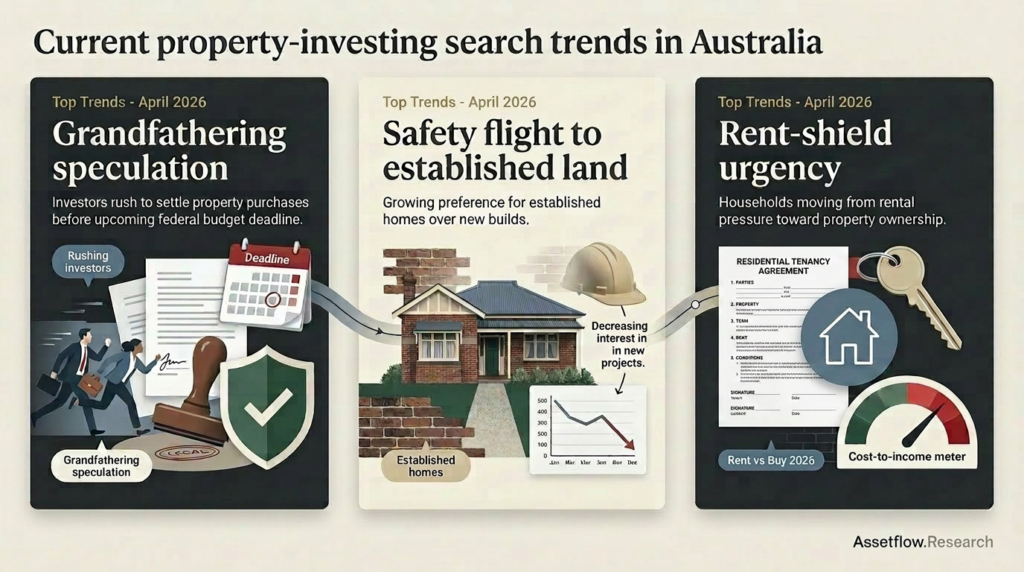
- The “Grandfathering” Speculation (Search Volume +350%): Google Trends data shows a massive breakout in searches for “Grandfathering Negative Gearing” and “CGT Reform May 2026.” With the May 12 Federal Budget only weeks away, the #1 trending topic is whether assets settled before the deadline will be protected. This has triggered a “Front-Running” effect; investors are rushing to settle now specifically to lock in the 50% CGT discount.
- The “Safety Flight” to Established Land: For the first time in years, search volume for “Established Homes”has surged past “New Builds” on major portals. Due to the 30% rise in builder insolvencies over the past year and July’s forecasted 6% jump in construction costs, the market has pivoted. People are searching for resilient landand houses already standing. Search interest for “1950s/1960s builds” has increased by 72% as buyers prioritize stability over construction risk.
- The “Rent-Shield” Urgency ($824/week Benchmark): With Sydney rents hitting a record median of $824 per week and national vacancy rates at a critical 1.0%, search volume for “Rent vs. Buy 2026” has hit an all-time high. Households are now committing a record 33.1% of gross income to rent. The data shows a desperate pivot: people aren’t searching for property as a “wealth play”; they are searching to escape a rental system that is now more expensive than a mortgage repayment.
4. Your 14-Day Action Plan
- Days 1–7: Perform a “Budget Window” Audit. The May 12 Federal Budget is the most significant date on the 2026 calendar. Sit down with your broker and accountant to stress-test your portfolio. Ask them: “If grandfathering rules are announced on May 12, am I positioned to lock in the current tax status?” If your team isn’t proactively modeling these scenarios, they are a bottleneck.
- Days 8–14: Define your “Lifestyle Floor.” In 2018, we moved to save two hours of commute time—that was a lifestyle necessity. Calculate your own “Floor”: the exact dollar amount of passive income your family needs to sustain your life without a 9-to-5. Stop looking at house prices and start looking at the Net Yield required to hit that number.
What I can offer: I’ve lived through the worry of renting out my first home and the chaos of buying a 1957 “time capsule” during a pandemic. I have lived through the anxiety while trying to catchup with the fast moving property market, I have faced challenges with brokers and banks, I have found a good team, I have suffered with poor advise, and I still feel everything was playing its role in helping me learn and bringing me to a point where I could decide to offer this as a service.
To help you structure your first move toward a real investment journey, I am offering a limited number of Mindset Review Sessions this month.
In this session, we will:
- De-code the “Fear of the First Move” by aligning your personal “Why” with current 2026 market data.
- Shift your lens from “Home” to “Asset” to ensure your first purchase protects your future borrowing capacity.
- Audit your “Support Squad” to ensure you have the right architects in your corner before the May Budget.
- Define your “Wealth Runway” so you stop saving for a perfect moment and start building for a real future.
You might wonder about how much this cost, right? It won’t cost you money as I am offering some of these sessions for free, however it would cost you time. I will give you an assignment to work on and have the session if you complete it in time. I only want to work with people who are serious about investments in property, or making a transition from doing nothing to seriously doing something! I want to make this session worth your time, and it would not happen if you treat this like just another webinar where you make notes and never look at them again!