This is the second post in a series of posts triggered by the 2026 Budget and its impact on Property Investing in Australia. If you haven’t, read the first Post Here.
The ground-level narrative across major property networks and investor circles has fundamentally shifted over the past few weeks. There is a palpable realization that we are no longer operating in a uniform, rising market. Instead, we have cracked open a highly fragmented, late-stage property cycle, supercharged by an aggressive macroeconomic double-whammy: the Reserve Bank’s previous cash rate hikes flattening borrowing capacities, followed immediately by the seismic property tax overhauls dropped in the May 2026 Federal Budget.
When we synthesize the current boots-on-the-ground sentiment from top property strategists, buyer’s agents, and investment channels, five dominant market narratives emerge.
Part 1: The Expert View – The Top 5 Property Market Narratives
1. The Death of the “One National Market”
Every serious analyst is pointing out the massive chasm between the tier-one capitals and the mid-sized powerhouses. Sydney and Melbourne have slipped into an explicit cyclical downswing, dropping over the last month according to recent CoreLogic data. Meanwhile, Perth, Brisbane, and Adelaide continue to shrug off higher interest rates, fueled by chronically low inventory. Buying blindly into “Australia” will get you hurt; geographic granularity is now the difference between outperformance and negative equity.
2. The “Affordability Ceiling” and Lower-Quartile Outperformance
With the RBA pushing borrowing capacity into the floor, a prominent theme is the dramatic flight to affordability. Across every major capital city, premium-tier and upper-quartile properties are stalling or dropping sharply, while entry-level, lower-quartile properties are consistently tracking upward. Demand has concentrated heavily where credit stretches furthest, rendering the lower-middle segments of resilient markets incredibly competitive.
3. The 12-Month Rental Cliff
For the first time in a year, SQM Research data revealed a slight uptick in the national residential vacancy rate, nudging from 1.0% up toward 1.2%. Prominent property educators are calling this the “first crack in the rental wall.” The narrative isn’t that the rental crisis is over—far from it, with national asking rents still painfully high—but rather that tenants have hit an absolute financial limit. In major hubs, people are downsizing, moving into share houses, or relocating because they simply cannot absorb further rent hikes.
4. The Grandfathering Rush
The May Federal Budget’s plan to dramatically restrict negative gearing and replace the 50% CGT discount with cost-base indexation on established properties from 1 July 2027 has sent shockwaves through investor networks. The current dominant advice isn’t panic; it’s a calculated call to action. Because existing assets purchased before the deadline will be fully grandfathered, the strategic narrative focuses on a 13-month window of opportunity to acquire high-quality, established dwellings before the rules change.
5. Inventory Spikes vs. Structural Undersupply
There is an active debate regarding listing volumes. In Sydney and Melbourne, advertised listings are tracking above their 5-year averages according to realestateinvestar and openstats.com.au, shifting the balance of power decisively toward buyers and dragging auction clearance rates down. However, industry experts are reminding investors not to mistake a localized, sentiment-driven supply lift for a structural solution. New dwelling construction continues to drastically undershoot underlying demand, meaning the macro structural floor beneath Australian housing remains firmly intact.
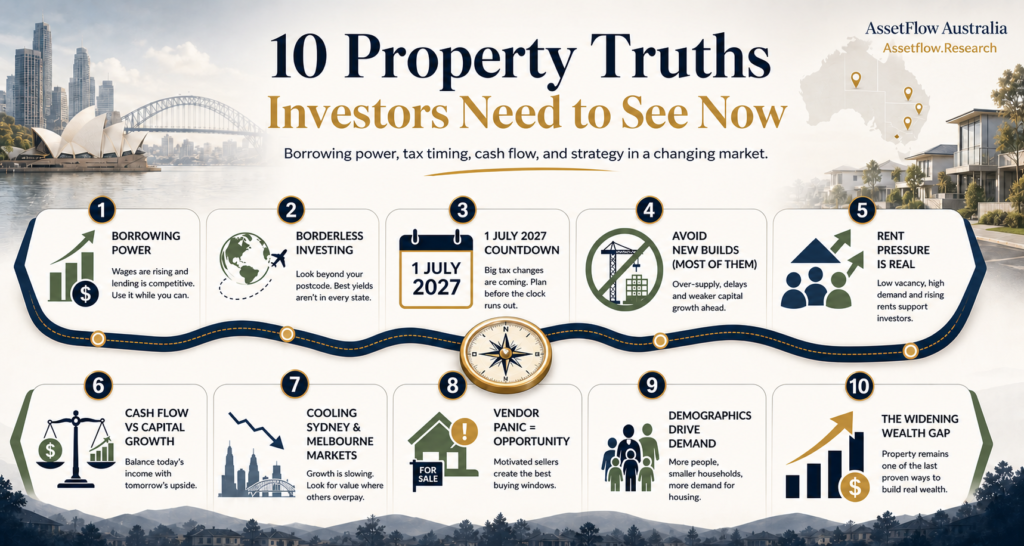
Part 2: The Ground Reality – 10 Things This Means For You
If you are trying to buy your first or second property right now, forget the high-level economic jargon. Let’s break down exactly how these shifts impact your wallet and your strategy:
- Your borrowing power dictates your target: You aren’t competing with the whole market; you are competing with everyone else who has had their budget slashed by the RBA. The entry-level market remains hot because that is where everyone is forced to shop.
- The “Borderless Investor” mindset is mandatory: If you live in Sydney or Melbourne, your local market is cooling, but your entry-level budget might buy you nothing but a tiny unit. To win, you need to look at interstate markets where land-heavy assets are still within your reach.
- A 13-month countdown clock is ticking: You have until 1 July 2027 to buy an established property under the current, more generous tax rules. If you buy a quality property before then, your tax benefits are locked in for the life of the investment.
- Ignore the “New Build” siren song: The government is exempting brand-new homes from the new tax rules to force people into buying them. Don’t fall into the trap. New builds often carry huge developer premiums and have a poor land-to-asset ratio.
- Tenants can’t pay infinite rent: The slight jump in vacancy rates to 1.2% proves that households are maxing out. When calculating your cash flow, do not assume you can increase the rent by 10% every single year.
- Cash flow is king, but capital growth wears the crown: With interest rates staying higher for longer, your holding costs are real. You need a property that delivers decent yield to support the mortgage, but it must be backed by land value to grow your wealth.
- The ball is back in your court in cooling markets: If you are buying in Sydney or Melbourne, days on market are stretching out. You no longer need to rush into a bad decision out of FOMO (Fear of Missing Out). Take your time and negotiate hard.
- Vendor panic is your opportunity: High listing numbers mean some sellers are genuinely stressed—especially those holding bridging loans or facing adjustable-rate cliffs. Look for motivated sellers who value a clean, fast contract over a record price.
- Demographics trump media headlines: Look at data from housing.id and the ABS. Capital growth follows population growth and wage increases. Find the suburbs where local industries are thriving and people actually have the money to pay more for housing.
- The wealth gap is widening: Those who sit on the sidelines waiting for interest rates to drop to 2% again will miss the boat. Markets move based on supply and demand, not just interest rates. The structural shortage of homes means the floor isn’t falling out.
Part 3: The Blueprint – Cut Through the Noise in 3 Steps
As Stuart Wemyss outlines in Investopoly, the secret to long-term wealth isn’t timing the market perfectly; it’s executing a repeatable, high-quality strategy regardless of the noise.
In The Armchair Guide to Property Investing, Ben Kingsley and Bryce Holdaway emphasize that a successful portfolio requires a clear, customized plan before you ever look at a real estate listing. If you want to cut through the current media storm and take an active, confident step forward within the next two to three weeks, follow this exact checklist:
Step 1: Lock in Your Absolute Financial Truth (Days 1–5)
Stop guessing what you can afford based on online calculators. Schedule an urgent strategy session with a savvy, investment-focused mortgage broker.
- Establish your precise borrowing ceiling under current servicing guidelines.
- Calculate your actual out-of-pocket holding costs at current interest rates, assuming a conservative vacancy buffer.
- Determine your available equity or cash deposit without leaving yourself entirely thin on cash reserves. As Morgan Housel notes in The Psychology of Money, keeping a buffer is the only way to survive the unexpected turns of life and markets.
Step 2: Draw Your Line in the Sand (Days 6–10)
Based on your budget, choose your strategy. Do not try to look at everything at once. This is what Margaret Lomas calls Investing in the Right Property Now!—matching the asset type directly to your personal financial requirements.
- If your budget is under $500,000: Turn your focus entirely toward high-performing regional hubs or affordable capital city rings (like parts of Adelaide, Perth, or regional Queensland) where you can still secure a freestanding house on a decent block of land with a vacancy rate well below 1.5%.
- If your budget is over $800,000: Focus on the cooling major capitals where stock is building. Identify A-grade, established properties (such as mid-century brick units or houses in tightly held inner-ring suburbs) where vendor expectations have softened, and prepare to submit low, realistic offers.
Step 3: Run the Numbers on 5 Real Opportunities (Days 11–15)
Open up realestateinvestar or openstats.com.au and select one targeted location that hits your brief. Find five properties currently on the market and run a brutal analysis on each.
- Check the suburb-level vacancy rate on SQM Research—if it’s above 2%, scratch the suburb off your list.
- Compare the asking price against recent comparable sales via CoreLogic data to ensure there is no premium pricing.
- Calculate the land component value (divide the land value by the total purchase price). You want the land to do the heavy lifting.
- Pick the top two properties from your list, pick up the phone, call the listing agents, and ask: “Why is the vendor selling, and what terms do they need to make a deal happen this week?”
What to Watch Next Week
Keep a close eye on auction clearance rates in Sydney and Melbourne. If they continue to hover below 55%, expect more vendors to withdraw properties or transition to private treaty campaigns, opening up excellent off-market opportunities for patient buyers.
Risk to Avoid: Do not let a real estate agent pressure you into an unconditional contract under the guise of “beating the budget tax rush.” A bad property bought today for tax reasons is still a bad property ten years from now. Focus on the structural fundamentals first, and let the grandfathering tax benefits simply be the icing on the cake.
Disclaimer: This article provides general information and educational commentary only. It does not constitute personal financial or investment advice. Before making any property investment decisions, you should seek independent financial, legal, and taxation advice tailored to your individual circumstances.