Honestly, I was just curious. I started digging into what the average Australian—from the seasoned investor to the hopeful first-timer—is actually searching for right now. I wasn’t just checking news headlines; I dove into the raw keyword data and aggregated reports from every source I could find.
What I saw wasn’t surprising, but it was confirming.
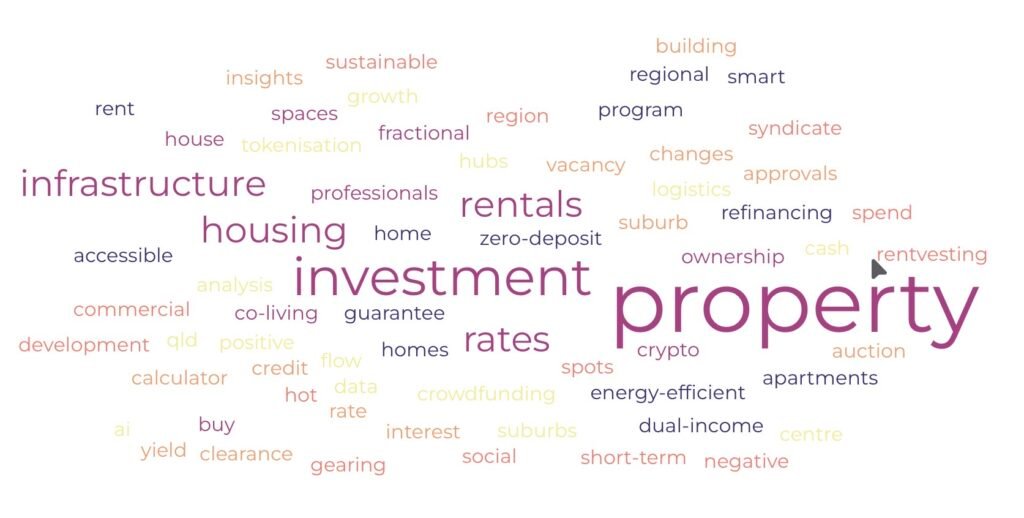
After cleaning up the list, I threw the results into a word cloud, and three massive themes exploded off the screen. If you’ve been on the fence, or if you’ve been doing non-stop research without taking the plunge, these are the forces shaping your next move.
The Capital Growth Hunt: The Bull is Back
The number one search theme this year revolves around “Capital Growth,” “House Prices,” and, most importantly, “Interest Rates.” Why the intensity? Because the market has found its mojo again, thanks to the RBA’s shift.
- The RBA Effect: We’ve seen the RBA make its third rate cut this year, bringing the cash rate target to 3.60%. This is a massive signal. As a fellow investor, I see this not just as cheaper money, but as renewed confidence flooding the market. Buyers are feeling better, which means more competition.
- The Price Surge is Real: The data confirms it. National dwelling values have been accelerating, up 0.8% in the last month and nearly 5% for the year.
- The Unit Value Shift: Here’s the sleeper pick that investors are starting to cotton onto: units are starting to outpace houses in terms of growth in several capitals. The smart money is noticing the sheer value gap—a gap that’s now closing.
- The Brisbane Story: I’ve been watching Brisbane and Queensland in general for years, but the latest data is a milestone: Brisbane has officially overtaken other capitals to become Australia’s second-most expensive city. That’s not a headline; that’s a new market hierarchy.
Cash Flow is King: Chasing That Positive Yield
Right alongside “Capital Growth” in the word cloud were “Rental Yield,” “Investor Hotspots,” and “Vacancy Rates.” This year is truly the return of the investor, purely because the rental market is an absolute gold mine.
- Why Investors Are Flooding Back: Tight, tight, tight rental markets mean rents are still climbing hard. Investor lending is at its highest level since 2017 because the numbers just stack up.
- Yields You Can’t Ignore: If you’re hunting for pure cash flow, the top-end yields are incredible. We’re seeing pockets in WA (Newman at 12.44%) and QLD (Pioneer at 12.04%) dominating the charts. Additionally property investors are looking for adding value to properties by adding features, improving the yields with Granny Flats and such…
- The Bigger Picture: Forget the outliers for a second. The projection for capital city median apartment rents to climb by 24% by 2030 is the market speaking. When demand is this strong, you can secure your cash flow position for years to come.
The Unfixable Supply Crisis (Your Long-Term Edge)
The third major theme, and the one that ultimately drives prices and rents, is “Housing Supply” and “Affordability.”
The frustrating reality is that all the government efforts and good intentions won’t solve the core problem overnight. Experts are clear: we need to build at least 240,000 new homes every year, but construction costs, labour shortages, and planning bottlenecks are keeping the brakes on.
What does this mean for you as an investor? It means the structural undersupply is your long-term moat. This crisis creates a decade-long runway for growth and tight rental markets, regardless of short-term economic wobbles. It’s the ultimate validation for buying and holding.
Here is your simple Call to Action: Stop Searching, Start Stacking
Fellow investors, the research phase is over. It’s time to move from theory to action. This market doesn’t wait for “keyboard warriors”—it rewards those who execute.
Let me make it easier (or difficult) for you with a two-month mission:
- For the Non-Planner (The Aspiring Investor or the Owner Occupier): You have until the end of the year to formulate your 2026 investment plan. Your only job in the next 60 days is to get an objective measure of your financial health.
Action Item: Book an appointment with a mortgage broker for a definitive serviceability check to know your exact borrowing capacity. No hypotheticals. No guesswork. Know your number so you can start shopping on day one of 2026. Get a number, the upper limit of what you can afford (use the FHG scheme in your considerations if that applies to you), and start making a note of what you could possibly buy with that amount. - For the Researcher (The Existing Owner/Active Investor): Stop refreshing your Google search results. You have the knowledge; now get the ammunition.
Action Item: Within the next 60 days, make calls to two professionals:- Call your existing lender/broker: Get a formal equity extraction estimate on your current home. Find out exactly how much usable cash you can pull out today. And then take action to get that equity in place. You might have to go through a re-financing cycle. Do it if required.. Get ready with a finance approval or a pre-approval and the deposit you need to pay for your next IP.
- Call your accountant/advisor: Get a valuation or estimate of your superannuation and a concrete report on whether an SMSF property purchase is a viable option for your next move. If it makes sense, figure out what needs to be done to set up the SMSF right, and get that done. Setting up the SMSF had a number of actions involved and will take some time, so the earlier you start the better. The point is, get ready!
Don’t just be interested in property investment. Be a person who takes objective action. Let’s move this from an idea to a contract before the year is out.
If you have reached till here, leave a comment or reach out in-person. This was general advice, however I’d love to talk to you about your personal situation and support you in your property journey! If you found value in this post, please consider sharing further!
Interesting read.. shared with a few newbies in Australia!
Thank you Isha! Hope the post added value…